The AI Revolution Is Rewriting the Rules of Wealth — And Most People Don't Know Which Side They're On
 Kamal Mehta Tech Visionary | AI Agent Builder | SaaS Architect | Mentor
Last Updated: March 06, 2026
"The decisions made between now and 2035 will likely determine the financial destiny of every person alive today."
That's not a dramatic headline. That's the quiet consensus forming among economists, AI researchers, and policy makers who are watching one of the most consequential shifts in human history unfold in real time.
We are living through the earliest years of an AI revolution that will — within a single generation — fundamentally change what work means, who gets paid, and who owns the future.
The question is brutally simple: are you positioned on the right side of it?

Part 1: What's Actually Happening With AI Right Now
Most people think AI is about ChatGPT writing their emails or generating an image for a social post. That's like thinking the internet was just about sending emails in 1995.
What's actually unfolding is far bigger.
The Three Waves of AI Disruption (2025–2060)
Researchers and economists studying labour markets are tracking this shift in three distinct phases:
Wave 1: The AI Integration Era (2025–2035) The first jobs to transform aren't the ones you'd expect. It's not factory workers losing their roles — it's the comfortable middle class: junior lawyers, accountants, junior developers, radiologists, customer service managers. The well-educated, well-paid knowledge workers who assumed their degrees protected them.
Why? Because AI is now exceptionally good at pattern recognition, data analysis, document summarisation, and structured decision-making — the exact tasks that fill a 9-to-5 office job.
At the same time, entirely new roles are materialising: AI Behavioural Auditors, Human-AI Interaction Designers, Synthetic Data Engineers, Digital Twin Managers. These jobs barely exist today. By 2035, they'll be some of the most sought-after careers on earth.

Wave 2: The Post-AGI Transition (2035–2045) This is where projections become harder — and the stakes become civilisational. If Artificial General Intelligence (AGI) — a system capable of reasoning across any domain at human level or beyond — is developed in this window, the pace of change accelerates beyond anything we've seen.
New roles that will define this era include AGI Alignment Researchers (ensuring superintelligent AI stays beneficial), Neuro-Interface Technicians, Quantum Software Developers, and something deeply human: Human Relevance Coaches — professionals who help people find purpose and meaning in a world where AI does most of the cognitive work.
Wave 3: The Post-Scarcity Transition (2045–2060) By this point, if projections hold, AI and robotics will have automated enough production that scarcity of basic goods — food, energy, healthcare, housing — becomes a solved problem in advanced economies. New professions emerge not around survival, but around what it means to be human: Consciousness Researchers, Virtual World Architects, Human Experience Designers, Genetic Ethics Counsellors.
What Survives — And Why
Three types of work are deeply resistant to automation, regardless of how powerful AI becomes:
1. Jobs that require you to be human. Grief counsellors, hospice workers, midwives, family mediators, spiritual leaders — these roles survive because the human presence itself is the product. An AI listening to you describe losing a parent isn't comfort. It's a simulation of comfort. People know the difference.
2. Jobs involving physical chaos. Plumbers, wildfire fighters, search and rescue workers, artisan craftspeople — robots remain surprisingly bad at unstructured, unpredictable physical environments. Every house, every emergency, every piece of handmade pottery is unique. The economics of deploying robots to handle genuine physical complexity still don't work at scale.
3. Jobs requiring democratic legitimacy or legal accountability. Society will not accept an AI sentencing a human to prison. We will not vote for algorithms. Judges, elected politicians, diplomats, and forensic investigators persist because the accountability attached to their decisions must sit with a human being.
Part 2: Here's the Part Nobody Wants to Talk About
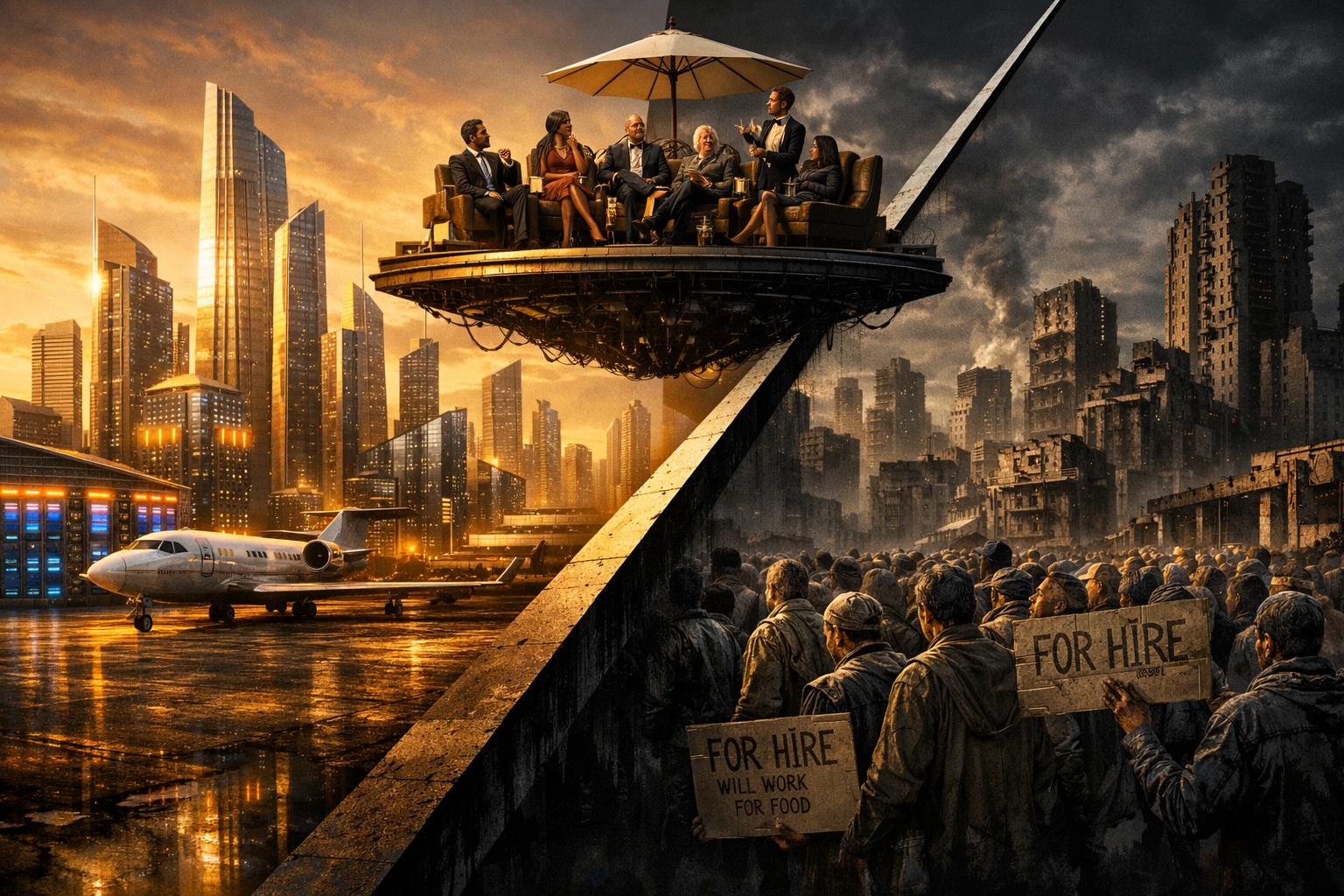
The AI revolution isn't just changing jobs. It's changing who owns the future.
AI Doesn't Earn a Salary
This is the economic mechanic that should keep everyone up at night.
When AI replaces a human worker, the productivity gains don't go to the worker who was replaced. They go to whoever owns the AI system. Every automated task is a transfer of value — from labour to capital.
Today, the top 1% of global wealth holders own roughly 45% of total global wealth. That concentration was built on centuries of industrialisation — a process where capital owned machines and machines made money. AI is the same dynamic, but running at a speed the industrial revolution never approached.
The Middle Is Hollowing Out
Labour economists call it polarisation. The jobs most at risk aren't at the bottom of the skill ladder — they're in the middle. Accountants, paralegals, junior developers, customer service managers — the reliable, respectable careers that built the global middle class over the last 50 years.
High-skill, highly adaptive roles survive. Low-skill physical labour (for now) survives. The middle — the economic backbone of most developed nations — faces the most pressure.
This isn't speculation. It's already measurable in wage data across the US, UK, and Europe over the last decade. AI accelerates what was already beginning.
The Ladder Is Being Pulled Up
For decades, developing economies in South Asia and Sub-Saharan Africa built growth by offering cheap labour for manufacturing and outsourced services — call centres, textile factories, data entry. It worked. It lifted hundreds of millions of people out of poverty.
AI and robotics are eliminating that pathway before billions of people have had the chance to use it. Countries like Bangladesh, Ethiopia, and the Philippines face a profound economic challenge: the ladder that wealthier nations used to climb is being removed just as they're reaching for it.
The Lifespan Gap — The Dimension Nobody's Discussing
By 2040–2060, life extension therapies — driven by AI-accelerated biological research — may allow people to live significantly beyond current lifespans. If access to these technologies follows the same pattern as every other major medical advance, they will initially be available only to the wealthy.
The result isn't just a wealth gap. It's a lifespan gap. The rich don't just accumulate more resources — they get more time to do it.
Part 3: The Two Futures — And What Determines Which One We Get
The Dark Scenario (if nothing changes)
A small class of AI and technology owners controls the majority of global productive capacity. The middle class largely disappears in wealthy nations, replaced by a bifurcated economy: high-earning AI collaborators at the top, and a vast population dependent on government support below. Social instability, political extremism, and the erosion of democratic institutions follow, because economic power has always eventually become political power.
The Hopeful Scenario (if we act deliberately)
Governments implement progressive taxation on automation — treating AI-powered productivity the way labour income was once taxed, and redistributing the proceeds as Universal Basic Income, free retraining, and public infrastructure. Open-source AI ensures that small businesses, entrepreneurs, and individuals in developing nations can access the same tools as trillion-dollar corporations. AI-generated abundance genuinely lowers the cost of food, healthcare, energy, and housing — raising the floor for the poorest, even as the ceiling rises for the wealthiest.
This isn't naïve optimism. It's historically grounded. The steam engine, electrification, and the internet all initially concentrated wealth — and eventually, through deliberate policy and social adaptation, spread their benefits broadly. The question with AI is whether our political institutions, built for a slower world, can move fast enough.

The Honest Truth
Technology is neutral. The wealth gap doesn't widen because of AI — it widens because of the policy choices humans make in response to AI. And those choices are being made right now, in the window between 2025 and 2035 that researchers keep flagging as decisive.
The people who will thrive by 2060 won't necessarily be the most credentialed, or even the most technically skilled. They'll be the most adaptable — the ones who understand what's coming, reposition themselves deliberately, and choose to stay informed and in motion rather than hoping their current situation holds.
Part 4: What This Actually Means For You
Here's the practical synthesis.
If your income comes from middle-skill cognitive work — document processing, standard analysis, templated communication, routine legal or financial tasks — the pressure on your role will intensify over the next decade. This isn't a reason for panic. It's a reason to start asking now what skills you're building alongside AI, not in competition with it.
If your work is deeply human — care, presence, physical complexity, creative vulnerability, democratic accountability — you are in a more resilient position than most think. The challenge isn't job security. It's ensuring your field is fairly compensated in an economy increasingly tempted to undervalue anything that can't be automated.
If you own a business, the AI tools available to you today represent an asymmetric advantage that didn't exist five years ago. Small teams can now accomplish what required large operations. The question is whether you're building that leverage or watching your competitors do it first.
If you're early in your career, you are entering the most uncertain — and potentially most opportunity-rich — labour market in history. The jobs that will define your peak earning years don't fully exist yet. Your greatest asset isn't your current qualification. It's your willingness to keep learning.
Where Do You Stand?
Every major technological revolution created a fork in the road — those who understood what was happening and adapted, and those who waited to see how it turned out.
The AI revolution is no different. Except this one is moving faster than the agricultural revolution, the industrial revolution, and the digital revolution combined.
Two futures are available. One concentrates everything — wealth, health, power, time — in the hands of those who own and understand AI. The other spreads abundance broadly, but only if enough people understand the stakes and demand the policies and personal decisions that make it possible.
Here's what I want to ask you directly:
🔹 Which side of this shift do you want to be on?
🔹 What is one concrete thing you are doing — or planning to do — in the next 12 months to position yourself there?
🔹 And honestly: do you think our political systems are capable of moving fast enough to prevent the dark scenario — or are we already watching it unfold?
Drop your answer in the comments below. Not a vague "I agree" — a real answer. What's your plan?
The conversation happening in the comments of posts like this one is, in its own small way, part of how the hopeful scenario gets built. Ideas spread. People connect. Movements start.
The scariest part of the AI revolution isn't the technology.
It's how few people are taking it seriously while there's still time to choose.
Found this valuable? Share it with someone who's still treating AI like a productivity tool and hasn't yet seen the bigger picture. They'll thank you for it.
Recent Posts
- Navigating the Shadows: Combating Tool Poisoning and Injection in Agentic AI
- Fortifying Agentic AI: Implementing Guardrails with Insights from MCPSafetyScanner and MCP Guardian
- MCP: The Crucial Link for Agentic AI in Web3, DeFi, and DAOs
- The MCP Revolution: How Microsoft and Cloudflare Are Building the Future of Agentic AI
- Kiro AI IDE Review: Building a Spec-Driven MVP
- 5 Essential Habits for Using ChatGPT Without Weakening Your Critical Thinking
- The Real Struggle with AI Coding Agents — And How to Overcome It
- Data Science: Your Comprehensive Guide to Concepts, Tools, and Career Paths
- Mastering Data Science with Python: Your First Steps into Pandas
- Kiro IDE: A Trailblazing Tool Risking Self-Sabotage Before Launch?